SCB Requests Review of Impacts of Tar Sands Pipeline on Whooping Crane
Keystone XL Pipeline Would Threaten Highly Endangered Whooping Cranes
WASHINGTON DC — As climate scientists, farmers, conservation groups and concerned citizens continue two weeks of protests at the White House in opposition to permitting a large new pipeline to carry partially refined tar from Alberta to the Gulf Coast, the world’s largest international conservation science society reminded the Obama Administration of the hazards the pipeline poses to the environment, particularly the highly endangered whooping crane.
“In addition to its well known climate change impact, the Keystone XL pipeline would threaten the whooping crane — one of the most highly endangered birds in the world — from one end of its migration route and habitat to the other,” said Dominick DellaSala, an ecologist and president of the North American Section of the Society for Conservation Biology.
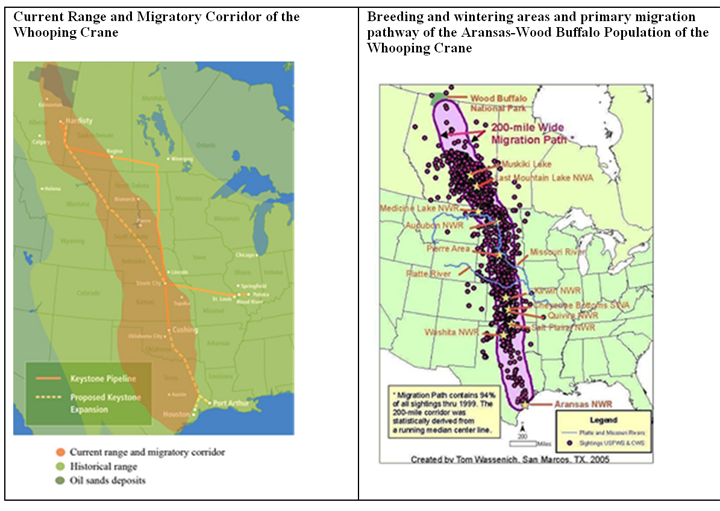
Last year, the Society for Conservation Biology (SCB) sent detailed comments to the State Department and other federal agencies explaining that the proposed pipeline and those it would connect to follows the migration of the endangered whooping crane for nearly its entire route. The risk of highly toxic oil spills and the dramatic expansion of tailing ponds could jeopardize the survival of the bird that the Fish and Wildlife Service calls one of the most famous symbols of America’s dedication to saving its wild national heritage.
While the Canadian Government is committed to the 1,700 mile-pipeline, its fate is in the hands of the U.S. State Department, which must decide by the end of this year to approve or reject a request for a permit for the pipeline to cross into US territory.
“The Secretary of State has no duty to issue a permit, but she does have a duty under several laws including the National Environmental Policy Act and the Endangered Species Act to consider alternatives and to choose safer alternatives,” said SCB Policy Director John M. Fitzgerald. “Furthermore, the Keystone XL decision provides the President the opportunity to direct Secretary Salazar to restore the rule that no US agency will jeopardize any species that the US lists as endangered, even if agency action results in harmful effects in another country.”
Jim Barrett, a Ph.D. economist and clean energy expert who co-chairs the SCB Investment Task Force, said the Keystone XL pipeline lacks a compelling economic component for creating jobs and is at odds with the president’s commitment to a clean energy future.
“As the Administration turns its focus to jobs and the economy, the Keystone XL project offers little prospect for either,” Barrett said. “With minimal impact on oil prices and a small number of short-term jobs created, the pipeline project will yield meager economic benefit in return for the substantial environmental costs it will impose on current and future generations.”
Barrett, whose studies have shown the benefits of federal support for efficiency and renewable energy, said the Administration can create jobs and promote clean energy with strategies that utilize new technologies.
“The Administration should be focused on a strategy of building new industries at home based on the technologies of tomorrow. This can create a virtuous cycle of job creation and reinvestment in American industries rather than exporting our national income for investment abroad.”
In its Recommendations to the Obama Administration in 2008 and its climate statements of 2009 and 2010, SCB outlined a better way forward based on restoring ecosystems, increasing efficiency and properly-placed renewable energy.
“We urge the President to apply that advice using his existing authority, and to work with Congress to reshape the federal budget accordingly to address the deficit and job-creation,” Barrett said.
Fitzgerald said that before the President addresses the nation on his budget and jobs proposals, and before the protests at the White House peak, both on September 3, the President should consider that:
1.) With only 74 breeding pairs in the core population near the tar sands, the whooping crane would be exposed to great risk from one end of its range to the other by the Keystone XL Pipeline;
2.) Obeying the Endangered Species Act and the National Environmental Policy Act fully would almost surely prevent approval of the pipeline given much safer energy alternatives;
3.) In the upcoming budget agreement, Obama and Congress can create lasting jobs to deliver renewable, safe energy while protecting the wildlife and environment of both nations.